What a tag is and why it matters
A tag is a keyword that groups a series of pages or posts under the same theme. A tag is meant to help visitors search and to suggest similar products or reading. It encourages them to stay longer on the website and keep browsing.
Increasing the time visitors spend on your website and the number of pages they view can have a significant impact on your search ranking: search engines such as Google will consider that your website is popular with visitors. It is one of the criteria you should not neglect for your positioning.
Which add-ons use tags?
Several add-ons let you use tags on emyspot:
- The blog add-on lets you classify posts with tags to offer cross-navigation and optimise their search ranking. Tags can be used as a cloud or by displaying a list of similar posts.
- The video gallery also offers this option so that visitors can watch videos on the same theme.
- Tags are also available with the directory add-on to simplify users' searches, whatever the number of entries.
- With the online store, the products in your catalogue are showcased and easier to identify.
How do you create a tag?
Whichever add-on you use tags in, the principle is the same: in the "tag" field, enter your keywords separated by commas. In general, you do not need to add more than 3 or 4 tags to a piece of content.
Always check first that a tag does not already exist under another spelling or with slightly different keywords before creating it, by looking at the list of tags already created. This list is available as suggestions just below the tag field; remember to click "+more" to display a new line.

How do you use tags well?
It is important to think carefully about your tag strategy before you start creating a blog, a directory or an online store.
For tags to be effective, it is best not to create too many and to make sure they can be used for several pieces of content. Each of the add-ons that use tags has a tab dedicated to managing them. You can see the list of existing tags, edit them, delete them or merge them.
- To search for a tag: type the name of the tag or a keyword in the "search term" field, then click "search".
- You can rename a tag by clicking the edit link just below the tag, then entering a new name in the first "tag" field, which is preceded by a red asterisk.
- You can also delete a tag that does not seem really useful because it is hard to reuse for other content. You will be asked to confirm after clicking the "delete" link below the name of the tag concerned.
- To replace a tag with another existing one, first click the "merge" link of the tag you want to remove. A drop-down menu then lets you select the name of the tag that will replace it.
Next, consider whether it is worth optimising the search ranking of your tag pages. A page is created automatically each time you use a new tag.
If the keyword used for this tag is likely to bring traffic to your website, it can be worth working on the tag page. You can then complete the SEO section linked to the tag: tag title, meta description or illustration image, and add an introductory text.
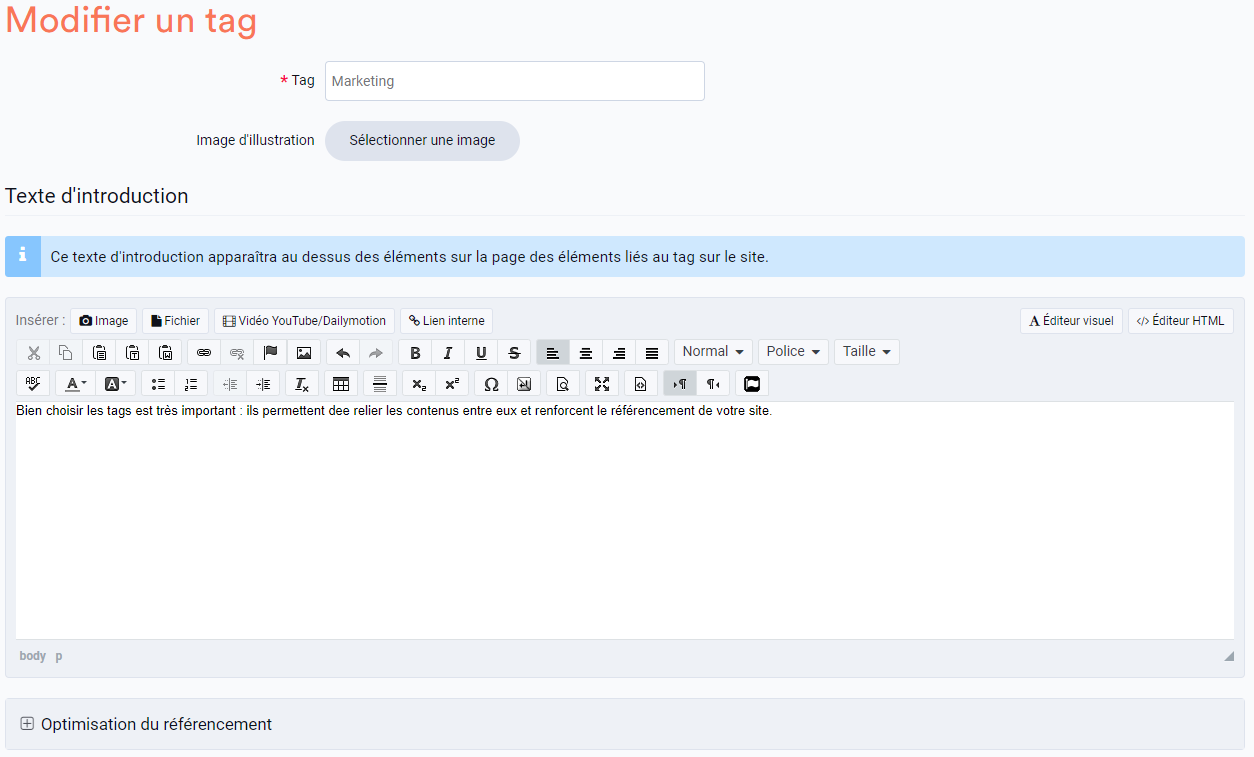
If it is not worth having the tag indexed, you can also stop the tag page from being indexed by ticking the "exclude from the sitemap" box in the search optimisation section.
These tutorials may also help you:
Display the list of similar posts
How to display a list of similar posts, to invite visitors to read other posts on your blog.
Managing content on a blog
Tips for creating a new post, writing it and organising your blog with a system of categories and tags.